
Concord NSW 2137

Infection control zoning for Concord clinics in shared commercial buildings

A clinic that shares a building with unrelated tenants has a boundary problem the tenants do not. Its standards apply inside its own door, but its patients arrive through a shared entry that somebody else specified and somebody else pays to maintain.

In short

Infection control zoning for a Concord clinic separates the tenancy into clinical, semi-clinical and general zones, each with its own equipment, method and sequence. It then addresses the shared approach separately, since the entry, stair and lift belong to the building rather than the practice and are outside the clinic's direct control.

Clean Best writes the tenancy scope to support the practice's own infection control policy rather than to replace it. The written proposal records equipment separation, the order of work and the tasks that remain with clinical staff, so responsibility is clear in both directions before the first attendance.

Three zones and the equipment that must not cross between them

Clinical zones are treatment and procedure areas. Semi-clinical zones include the areas patients occupy without treatment: waiting, corridors, the public toilet. General zones are administrative and staff areas with no patient presence. Each needs its own colour-coded cloths, mop heads and buckets, stored separately and never rotated. This is the single control that most reliably distinguishes a scope written for a clinic from one written for an office.

Sequence matters as much as equipment. Work moves from the lowest risk area to the highest, or with a full change of equipment between them, so nothing is carried backwards. The plan writes this out explicitly rather than assuming the cleaner will infer it. A relief attendance is exactly the situation where an unwritten convention fails, and it is also the situation where the practice has least visibility over what happened.
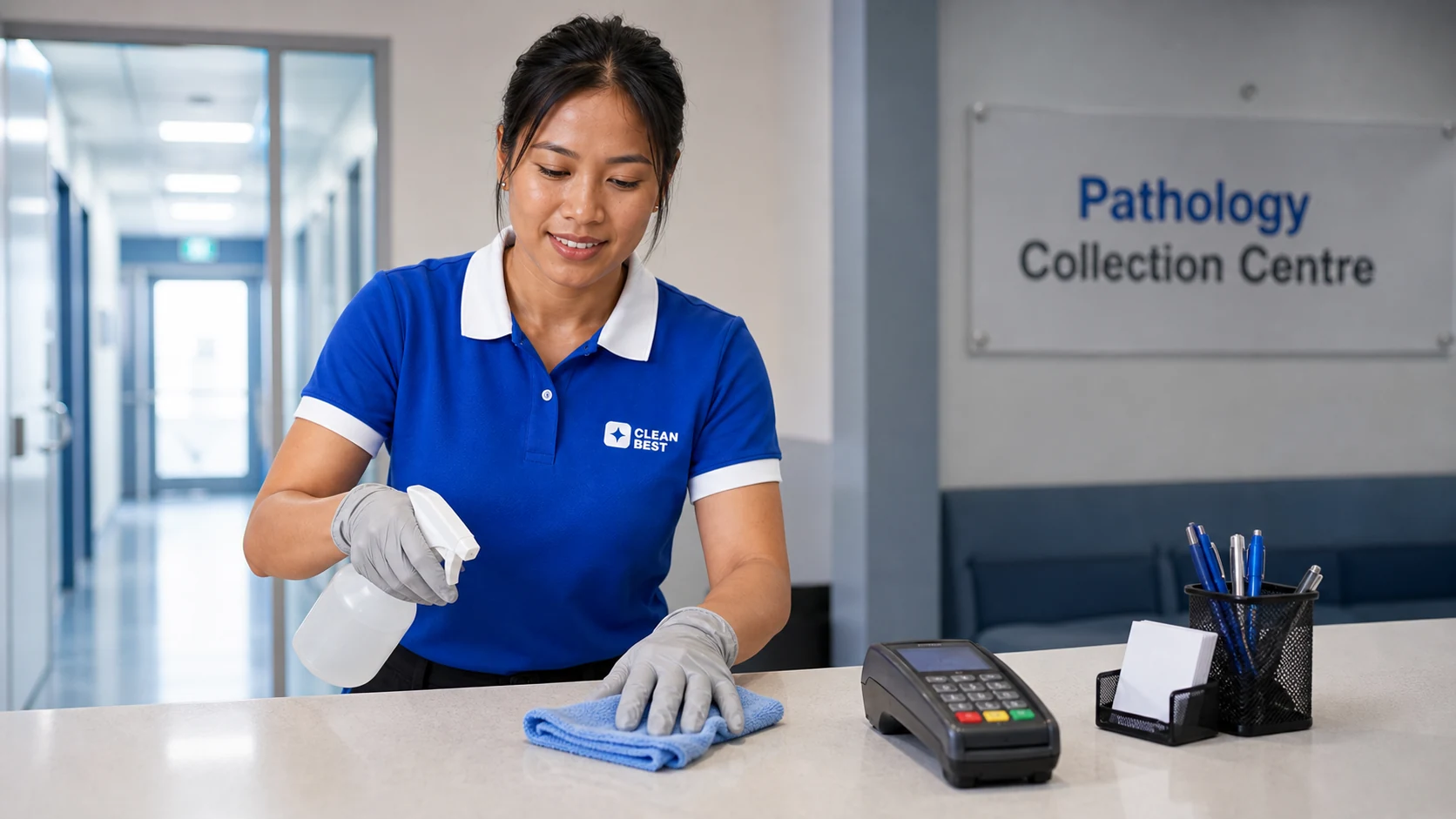
What stays with clinical staff

Between-patient surface decontamination, equipment reprocessing, sharps handling, spill management involving body fluids and clinical waste disposal sit with the practice and its trained staff under its own policy. A general cleaning contractor supports the environment around those tasks. The plan should state this in plain terms, because a scope that implies broader coverage exposes the practice at exactly the moment it needs clarity.

The corollary is that the cleaning scope should be precise about what it does deliver: terminal cleaning of rooms at the end of the day, floors, general waste, touchpoints, replenishment of general consumables and periodic detailed work. Stated that way, the practice can slot the contracted tasks into its own infection control documentation and see exactly where its internal responsibilities begin and end.

The shared approach the clinic does not control

Patients form an impression, and in some cases carry a risk, from the shared entry and stair before they reach the clinic door. The practice cannot rewrite the building's common property scope, but it can raise the specific issues that matter: handrail and lift button frequency, entry matting condition and the state of any shared toilet its patients use. Those are reasonable requests supported by the nature of the tenancy.

Where the building will not lift the common standard, the practice has options worth recording in its own plan. It can extend its tenancy scope to include the landing immediately outside its door by agreement, add its own hand hygiene provision at the entry, or adjust its internal frequencies to compensate. Writing the decision down is what stops it being revisited informally every time somebody notices the stair.

Zoning controls for a Concord clinic tenancy

  • Clinical, semi-clinical and general zones named room by room
  • Colour-coded equipment sets stored separately per zone
  • Written order of work from lowest to highest risk
  • Explicit list of tasks remaining with clinical staff
  • Terminal clean content defined for each room type
  • Position agreed on the shared entry and stair
Clean Best team reviewing hygiene tasks in a Blacktown facility

Working in Concord and the Inner West

Concord in the Inner West carries healthcare, schools, local retail and professional premises, with a number of clinics and allied health practices occupying suites in shared commercial buildings rather than standalone medical centres. That arrangement puts a practice's standards inside its own door while its patients arrive through common areas maintained to a general commercial specification. Managing the join is the planning task. Clean Best services Concord from Seven Hills and writes tenancy scopes that sit alongside a practice's own infection control policy.

Questions about Concord

Does colour coding actually make a difference?

It is the most practical control available in a small tenancy, because it removes reliance on memory. A cleaner who has never attended the site can see which equipment belongs where. Without it, the sequence and separation depend entirely on the individual, and the first relief attendance is where that breaks down. The cost of implementing it is negligible.

Can the same person clean the clinic and the building?

It is workable provided the equipment sets stay separate and the sequence runs from the building's general areas into the tenancy rather than the other way. What should not happen is common area equipment being carried into clinical zones. The plan records the sequence explicitly where one contractor holds both, since the risk is otherwise created by convenience.

What is included in a terminal clean of a treatment room?

Typically floors, all horizontal surfaces, touchpoints, basin and taps, waste removal, replenishment of general consumables and a check that the room is ready for the next session. It does not include instrument reprocessing or anything requiring clinical training. The scope lists the tasks by room type so there is no ambiguity when accreditation questions arise.

How should a body fluid spill be handled?

Under the practice's own policy by trained staff, not by a general cleaner arriving that evening. The plan states this clearly. What the cleaning scope can cover is the subsequent routine cleaning of the area once the practice has managed the spill, and the plan should note any additional treatment required before the room returns to normal service.

Can we ask the building to lift the common area standard?

You can raise it with the owner or manager, and a clinical tenancy is a reasonable basis for asking, particularly regarding touchpoints on the patient route. Whether it is agreed depends on the building. If it is not, the practice can extend its own scope to the immediate approach by arrangement, and the plan should record whichever position is reached.

Get a fixed written quote for Concord

Free walkthrough, scope in writing, price back within 24 hours.

Request a quote
Call nowEmail us