
Kogarah NSW 2217

Consulting room turnover planning for Kogarah healthcare and professional suites

Between one appointment and the next there are perhaps four minutes. What happens in those four minutes is not the cleaning contract's work, but the contract has to be written so the two do not collide or duplicate each other.

In short

In a Kogarah consulting suite, between-session turnover is generally performed by clinical or reception staff, while the cleaning arrangement covers the end-of-day service, amenities, circulation and periodic work. A facility plan states which tasks belong to each, so nothing is done twice and nothing is assumed to have been done by the other party.

Clean Best documents that split during the walkthrough, including which surfaces the practice wipes between patients and which the nightly attendance covers. The proposal is fixed and issued after inspection, and cleaner screening evidence is available for the practice's contractor records.

Two different jobs happening in the same room

Turnover between sessions is fast, targeted and clinically directed. It deals with the examination surface, the immediate touchpoints and anything the previous consultation generated. The end-of-day clean is broader and slower: floors, the full surface set, waste, amenities and the parts of the room that turnover never reaches. Confusing the two produces either a rushed clean or a turnover that takes longer than the appointment schedule allows.

The plan should list them separately and name the owner of each line. Where the practice performs turnover, the cleaning scope says so explicitly rather than staying silent. Silence is what causes a practice manager to assume the cleaner covers a surface and a cleaner to assume clinical staff do, which usually surfaces during an accreditation review rather than in ordinary operation.
Products, consumables and who supplies what

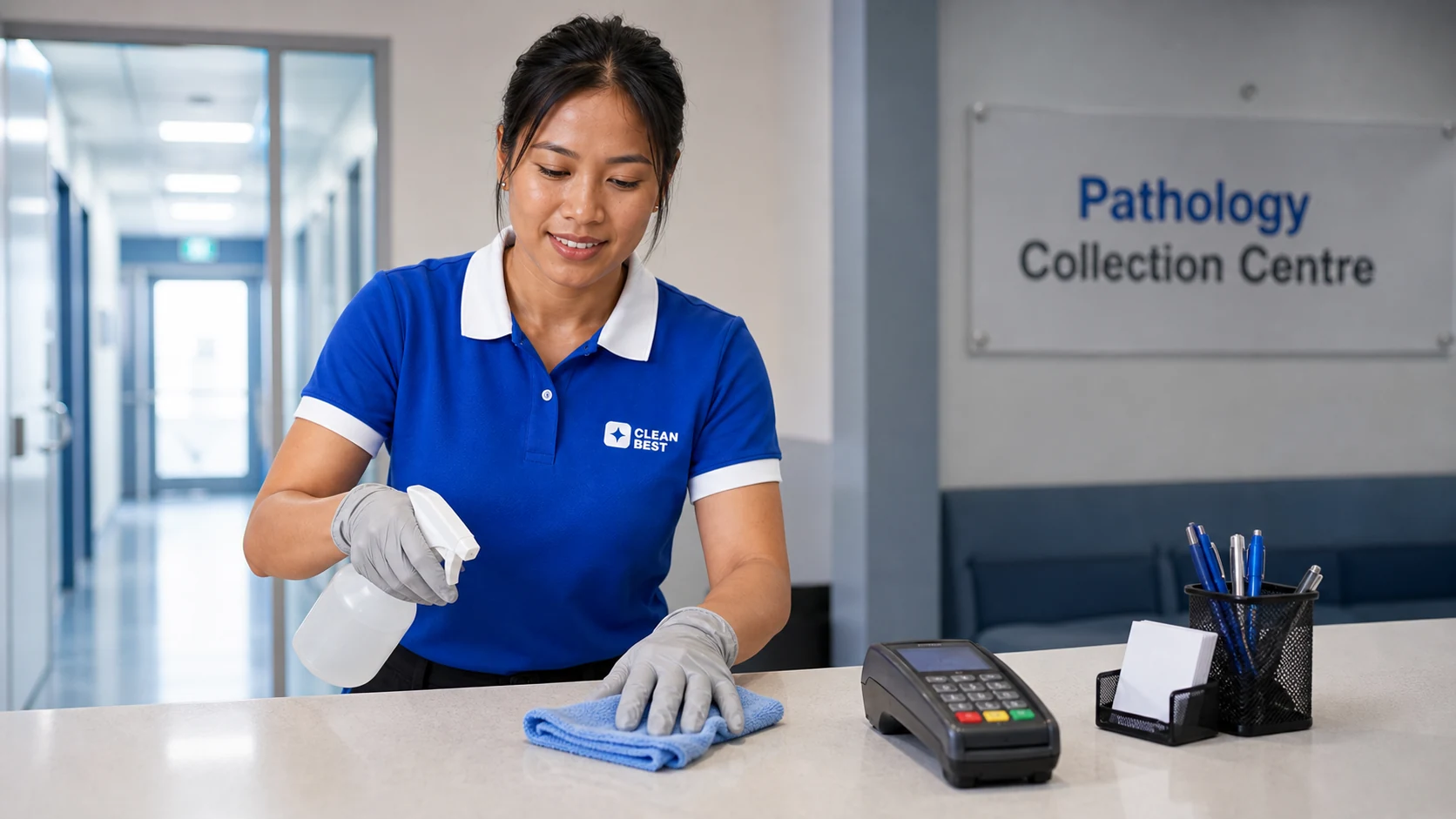
Practices frequently specify their own products for clinical surfaces, which is reasonable and should be recorded. The plan needs to say which products are used where, who supplies them and where they are stored, particularly where a cleaning contractor supplies general areas and the practice supplies clinical ones. Mixed supply arrangements work well when documented and poorly when they rely on whoever notices a bottle running low.

Consumables follow the same logic. Hand towel, soap and clinical waste bags may come from different sources with different lead times, and running out of any of them affects the practice rather than the contractor. Recording the supply responsibility, the check frequency and the reorder trigger converts a recurring irritation into a scheduled task that somebody owns.

Waste streams and what a cleaner does not handle

Clinical waste is handled under its own regulated arrangements and is not part of a general cleaning scope. The plan should state that clearly, along with what the cleaning attendance does around it: emptying general waste, replacing liners, cleaning the exterior of bins and the surrounding floor, and reporting anything that appears to be in the wrong stream. Sharps containers are never handled beyond reporting a full one.

The boundary works best when it is spatial as well as procedural. If clinical waste is consolidated in a defined room or bay, the cleaning scope can cover the floor and the approach while excluding the containers themselves. That gives a cleaner an unambiguous rule and gives the practice confidence that its regulated stream is not being touched by someone outside its own procedures.

Splitting turnover and cleaning in a Kogarah suite

  • Between-session tasks listed with the practice named as owner
  • End-of-day tasks listed separately for each room type
  • Products specified by surface, with the supplier identified
  • Consumable supply responsibility and reorder trigger
  • Clinical waste excluded, with the surrounding area included
  • Sharps containers reported rather than handled
Clean Best team reviewing hygiene tasks in a Blacktown facility

Working in Kogarah and the St George

Kogarah in the St George area has a strong concentration of healthcare alongside professional offices, education and retail premises, with consulting suites frequently occupying converted floors in buildings that also house unrelated tenancies. Suites of that kind operate to an appointment schedule that leaves very little slack, and they often share a lift lobby and amenity block with occupants who have no clinical requirements at all. Keeping the two sets of expectations distinct is the practical task. Clean Best services Kogarah from Seven Hills and sets attendance times against realistic travel.

Questions about Kogarah

Should cleaners be in the building during consulting hours?

Generally the main attendance sits outside them, for privacy as much as for practicality. Where a suite runs long hours and needs a daytime presence for amenities and waiting areas, it is scoped as a short defined attendance with a named area list that excludes consulting rooms in use. Access to occupied clinical space is always directed by practice staff.

Can you follow our infection control procedures?

Clean Best works to the client's documented requirements for the areas concerned, including specified products, sequence and equipment separation. What the plan will not do is claim responsibility for clinical procedures that belong to the practice. The written scope records exactly which requirements the cleaning attendance follows, so an accreditation review has something specific to look at.

Who cleans the examination couch and clinical surfaces?

In most practices, clinical staff between patients, because those surfaces are handled as part of the consultation rather than as building maintenance. The nightly attendance can cover them as well if the practice prefers, using products the practice specifies. Either arrangement works; what causes problems is neither party being sure which one applies.

How do you handle privacy and patient records?

Desks, reception areas and any surface holding records are treated as exclusion areas unless clear, and nothing is moved or read. The plan can name specific rooms as restricted or require an escort. Cleaners are police checked and confirmation is available for practice records, and any additional screening the practice requires is identified before rostering.

Are amenities shared with other building occupants?

Frequently, and that changes the frequency calculation. A toilet block serving a consulting suite plus two unrelated tenancies carries a combined load and needs servicing against total users rather than the practice's own numbers. Where the block is common property, its scope usually sits with the building rather than the suite, and the plan records which applies.

Get a fixed written quote for Kogarah

Free walkthrough, scope in writing, price back within 24 hours.

Request a quote
Call nowEmail us