
Campbelltown NSW 2560

Room type frequencies for Campbelltown healthcare and professional premises

A waiting room, a consulting room and a staff room sit within twenty metres of each other and need three different frequencies, three different methods and three different standards of evidence. Practice managers who plan by floor area rather than by room type inherit all three problems at once.

In short

Planning by room type means each category of room in a Campbelltown practice carries its own task list and interval. Waiting areas are driven by public traffic, consulting rooms by session turnover and clinical requirements, staff areas by occupancy. The schedule then reflects how each room is actually used rather than distributing effort evenly across the floor plate.

Clean Best records room types during the walkthrough and prices them individually within one fixed written proposal. Clinical requirements set by the practice remain the practice's own standards; the cleaning scope is written to support them and states plainly where responsibility for clinical tasks stays in house.

Three room types, three sets of pressures

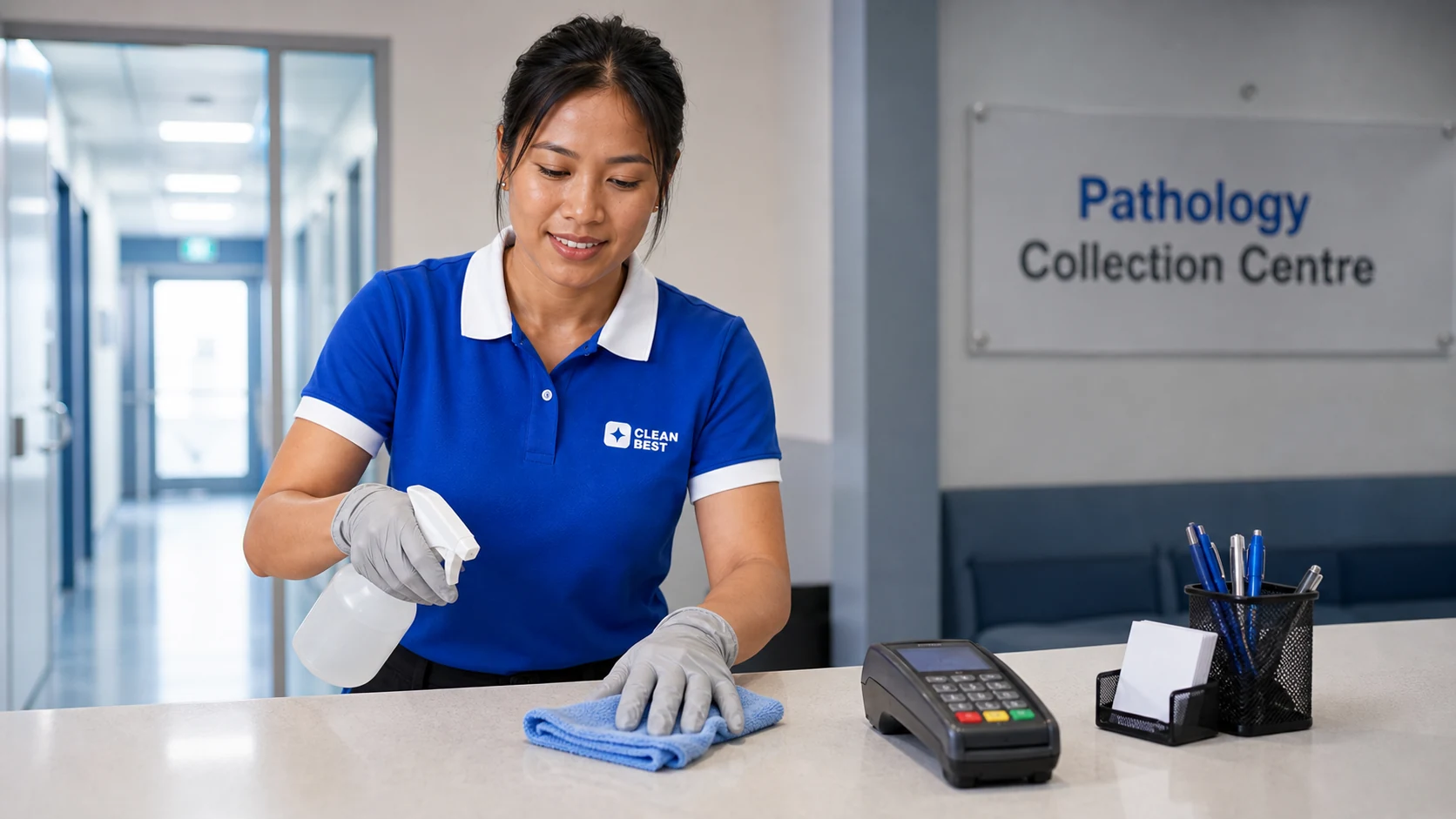
Waiting areas absorb the practice's entire visitor volume. Seating, floor, entry glass, reception counter and the public toilet take continuous use, and their condition is what a patient forms a view from. These rooms need frequent, visible attention and are the natural candidates for any daytime component in the plan, because condition at four in the afternoon is what most people actually experience rather than condition at seven in the morning.

Consulting rooms behave differently. They are used in short repeated sessions, and what matters is the state at the start of each one rather than the accumulated state at the end of the day. Between-session tasks generally belong to clinical staff following the practice's own protocols. The cleaning scope covers the end-of-day reset, floors, waste removal, touchpoints and replenishment, and it should say clearly that it does not substitute for clinical cleaning during the day.
Staff areas and the parts nobody sees

Staff rooms, tea preparation areas, storerooms and back corridors are consistently under-scoped in practices because they are not seen by patients. They are, however, the areas staff experience most and the ones that generate the strongest internal complaints. A modest but reliable frequency in these spaces does more for retention and daily morale than an additional pass through a waiting room that was already acceptable.

There is also a practical reason to include them properly. Staff kitchens generate odour and pest risk faster than any other room in a small building, and a storeroom that is never attended accumulates dust that eventually migrates. Giving these rooms a stated frequency, even a modest one, prevents the drift where they are attended only when someone remembers or when a visitor is expected.

Evidence and what the practice keeps in house

Practices are frequently asked to demonstrate that cleaning occurs to a defined standard. The plan supports that by stating the tasks, the intervals and the review arrangement in writing, and by recording periodic work against dates. What it should not do is imply that a general cleaning contractor is performing clinical decontamination or handling regulated waste, because those obligations sit with the practice and its own trained staff.

Drawing that line explicitly protects the practice more than a vague inclusive scope would. When an accreditation question arises, the practice can point to a document showing exactly which tasks are contracted, which are internal, and how each is evidenced. A scope that gestures at covering everything provides no such clarity and tends to collapse under the first specific question about a particular clinical requirement.

Room-type planning for a Campbelltown practice

  • Waiting area frequency set against patient volume
  • Public toilet cycle including a daytime check where justified
  • Consulting room end-of-day reset defined precisely
  • Clear statement that between-session clinical tasks are in house
  • Stated frequency for staff room, kitchen and storerooms
  • Periodic items recorded against dates for accreditation evidence
Clean Best team reviewing hygiene tasks in a Blacktown facility

Working in Campbelltown and the Macarthur

Campbelltown in the Macarthur region carries healthcare, education, retail, government and professional offices, with a substantial concentration of medical and allied health premises around its centre. Many are multi-practitioner suites where public, consulting and staff areas sit within a single tenancy and are used on entirely different rhythms. Planning those by room type rather than by area is the practical distinction. Clean Best services Campbelltown from Seven Hills and writes scopes that state clearly where cleaning responsibility ends and clinical responsibility begins.

Questions about Campbelltown

Does a cleaning contractor handle clinical waste?

No. Clinical and sharps waste stay within the practice's own contracted stream and are handled by trained staff following its protocols. The cleaning scope covers general waste only, and the plan states that plainly. Any bin outside the general stream found in a common area is reported rather than moved, which protects both the practice and the cleaner from a foreseeable problem.

How often should a public waiting toilet be cleaned?

In a busy practice, at least daily with a mid-day check. Overnight cleaning alone cannot hold condition through a full day of patient use, and the toilet is the single item most likely to shape a patient's view of the premises. Whether the mid-day check is a short scheduled round or a staff task is a decision the plan should record explicitly.

What does the end-of-day consulting room reset include?

Typically floors, waste removal, touchpoint wiping, basin and bench surfaces, replenishment of general consumables and a visual check that the room is presentable for the next session. It does not include equipment reprocessing, instrument handling or any task requiring clinical training. The scope lists what is covered so nothing is assumed in either direction.

Can cleaning happen while the practice is open?

Waiting areas and public amenities often need it, and that can be arranged as a defined daytime round. Consulting rooms are generally cleaned after the last session because they are occupied throughout the day. The plan sets out which rooms are eligible for daytime work and what happens when a room remains occupied past the scheduled attendance.

How do you evidence that periodic work was done?

By recording it against a date in the plan and confirming completion when it occurs. Floor treatment, detailed amenity work and high dusting all sit on stated intervals rather than being described as occasional. That record is what allows a practice manager to answer an accreditation question with a document instead of a recollection of roughly when something last happened.

Get a fixed written quote for Campbelltown

Free walkthrough, scope in writing, price back within 24 hours.

Request a quote
Call nowEmail us